

I’ve audited enough Shopify stores to know what bad goal setting looks like. It’s not chaos. It’s worse. It’s a team that’s confident. They pull up their analytics dashboard, see conversion events ticking up week over week, and decide things are moving. Meanwhile revenue stays flat for the third month in a row.
What’s happening is almost always the same thing. They’re measuring activity without measuring intent. They’re tracking newsletter signups, wishlist additions, and product page views. Everything labeled as a conversion. Everything mixed into the same report. None of it connected to a purchase.
That’s not a data problem. It’s a goals problem. And it’s more common than most founders want to admit.
Understanding macro vs micro conversions is how you fix it. Not because it’s a theory exercise, but because the moment you separate the two, your CRO priorities become obvious.
This is a concept I keep coming back to when reviewing conversion systems for e-commerce brands. If you want the full strategic picture of how conversions work across the funnel, start with [Conversion in Digital Marketing (E-commerce): Definition, Examples, Metrics, and How to Improve It]. It covers the broader framework this article builds on.
What a macro conversion actually is
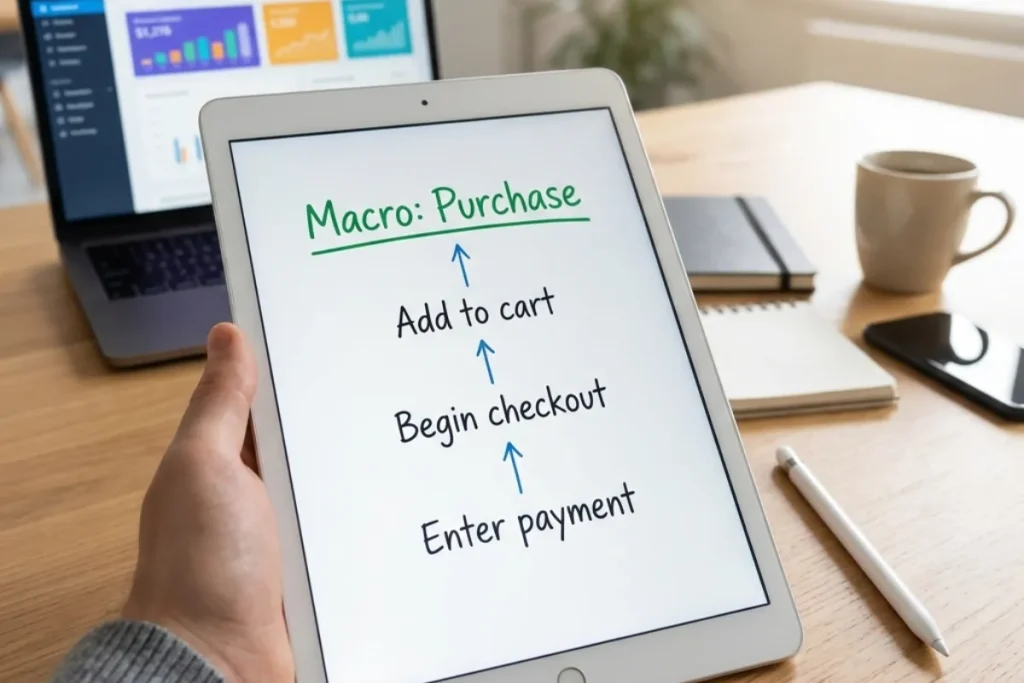
The macro conversion is the action that directly fulfills your business objective. For most e-commerce stores that’s a completed purchase. Not an add to cart. Not a checkout start. The actual order confirmation.
Some stores have more than one macro conversion depending on their model. A subscription box brand might define a macro conversion as a completed subscription signup. A brand selling expensive products might treat a sales call booking as a macro conversion if the purchase happens off site. The key is that a macro conversion either generates revenue directly or represents a high value commitment that predictably leads to revenue.
Everything else is support. The macro conversion is your true north.
Micro conversions: diagnostic tools not success metrics
Micro conversions are the steps that precede the macro. They fall into two types.
The first type is process milestones. These are actions that are part of the direct path to purchase: adding a product to cart, entering shipping details, reaching the payment step. These are sequential. A customer typically can’t complete a purchase without passing through each one.
The second type is secondary actions. Behaviors that signal intent without being required checkout steps. Reading reviews, zooming into product images, signing up for an email list, clicking a size guide. These tell you something real about how engaged a visitor is but they’re not part of the direct purchase path.
The mistake most teams make is treating micro conversions as wins in themselves. They’re not. They’re signals. A high add to cart rate with a low purchase completion rate doesn’t mean your product page is working. It means your checkout has a problem. A high email signup rate with no downstream purchases means your email flow isn’t converting, or your subscribers aren’t the right audience.
Micro conversions are most useful when something in your funnel is broken and you need to find exactly where.
The hierarchy problem that ruins most reporting
Here’s what I see constantly: a brand tracks 12 different events in GA4, labels six of them as conversions, runs a monthly report, and calls it performance tracking. Nothing in that report tells them which conversion actually moved the needle on revenue.
When everything is a conversion, nothing is a conversion.
The fix is a simple hierarchy. You define one macro conversion, or at most two. Everything else becomes a secondary metric or a funnel KPI. The reporting structure reflects that hierarchy. If your macro conversion rate drops, you then look at your micro conversion data to diagnose which step broke.
You stop guessing and start reading the funnel as a system. A drop in purchase completions triggers a review of checkout step data. A drop in checkout initiations triggers a review of add to cart and product page performance. Each layer has its own KPI and each KPI is subordinate to the one above it. That’s how CRO stops being reactive.
Building a funnel goal map for your store
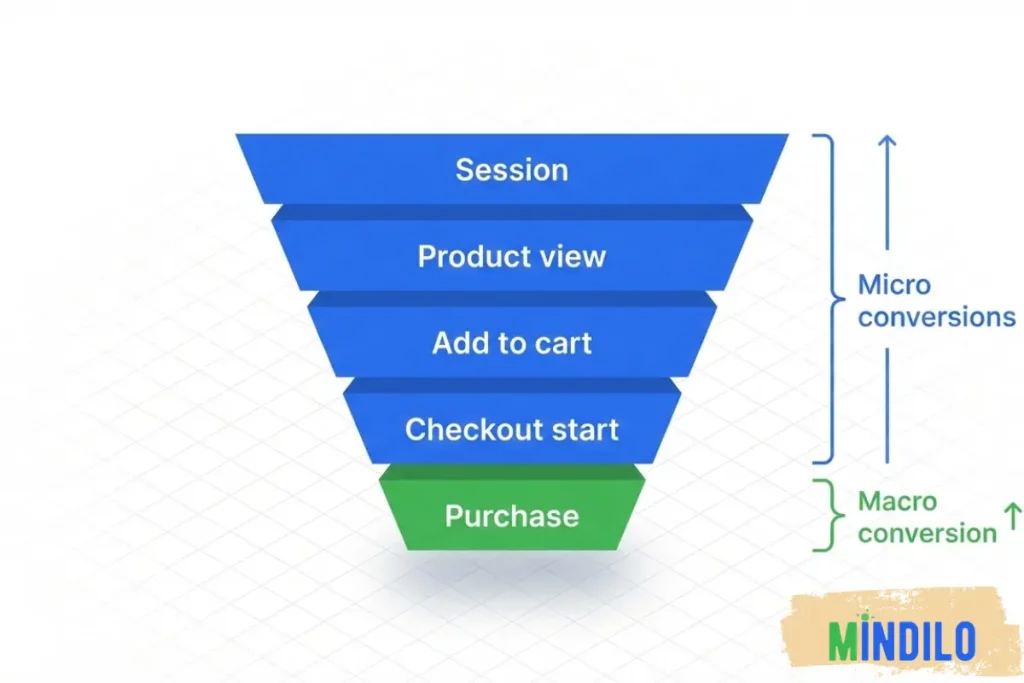
The practical version of this is straightforward. You map your full conversion funnel as a sequence of steps, then assign a measurable rate to each one.
For a standard e-commerce store it looks something like this:
Session > Product page view > Add to cart > Begin checkout > Enter shipping > Reach payment > Purchase
That’s your funnel. The last step is your macro conversion. Every step before it is a micro conversion with its own completion rate. You calculate each rate by dividing the number of users who completed that step by the number who entered it.
When you structure your ecommerce conversion goals this way, something useful happens. You stop asking “how’s our conversion rate?” as a single question and start asking “where in the funnel are we losing the most people?” Those are very different questions. Only the second one leads somewhere actionable.
If 8% of sessions add to cart but only 22% of those reach the payment step, your checkout is the bottleneck. Fix that before you touch anything else. That’s what makes CRO compound over time instead of producing random results from random tests.
Once your goal map is in place, the next step is making sure you’re measuring each rate correctly. That’s a bigger question than it sounds, and I cover it in detail in [Conversion Rate Explained: How to Calculate It (and Which Version to Use for E-commerce)].
How to set this up without overcomplicating it
Start with one question: what is the one action, if completed, that I’d consider this visitor a success?
That’s your macro conversion. Write it down. Make sure your whole team agrees on it before you touch your analytics setup. Then build your funnel map working backward from that action. Each prior step becomes a tracked event in your analytics. You’re not labeling them as conversions in your reporting tool. You’re treating them as funnel KPIs.
In GA4 you’ll mark your macro conversion as a key event. Your micro conversions stay as tracked events you can view in the funnel exploration or path reports. That keeps them useful without letting them inflate your main conversion metric.
Keep the goal list short. Three to five tracked funnel steps is enough for most stores. More than that and you’re measuring the map instead of moving through it.
FAQ
What’s the difference between a macro and micro conversion in e-commerce?
A macro conversion is the action that directly achieves your business goal, usually a completed purchase. Micro conversions are smaller steps along the way: adding to cart, starting checkout, or entering shipping details. Micro conversions help you understand user behavior and identify where people drop off. They support your macro goal but they don’t substitute for it.
Can tracking micro conversions actually help increase sales?
Yes, but only if you use them diagnostically. If your purchase rate drops, micro conversion data tells you which step broke. If 60% of users drop between reaching the payment page and completing the order, that’s a specific checkout problem you can fix. Micro conversions turn vague revenue problems into addressable friction points.
How many conversion goals should I track in my store?
Most stores track too many. Start with your macro conversion and three to four funnel steps that lead to it. That’s enough to build a clear picture of where users fall off. Adding more events is fine but keep them out of your primary conversion report. Your main dashboard should focus only on what connects directly to revenue.
Getting your goals right changes everything
Most CRO work fails not because of bad tactics but because teams are optimizing against the wrong goals. When your conversion goal structure reflects actual revenue intent, everything downstream gets sharper: your tests, your prioritization, your reporting.
Macro vs micro conversions isn’t a complex technical concept. It’s a thinking tool. Once you apply it properly, you’ll spend less time celebrating metrics that don’t matter and more time fixing the ones that do.
If you haven’t mapped out what conversion means for your store at a systems level, that’s the right place to start. The pillar article [Conversion in Digital Marketing (E-commerce): Definition, Examples, Metrics, and How to Improve It] walks through the full framework.