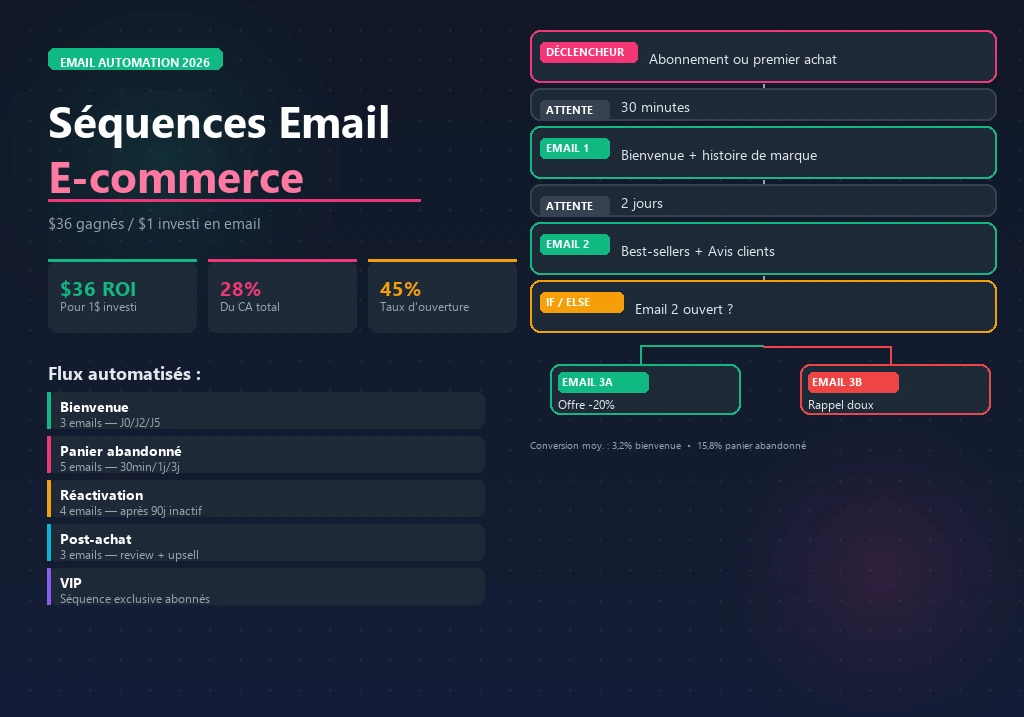

Email marketing automation for ecommerce is still the highest-ROI channel available — $36 back for every dollar spent, and up to $72 in the US market. But that return doesn’t come from sending newsletters. It comes from automation: triggered sequences that reach the right customer at the right moment without manual work each time.
The problem isn’t that email marketing tools don’t exist. It’s that too many ecommerce founders pick the wrong one for their stage — paying Klaviyo prices when Omnisend would do the job, or staying on MailerLite when they’ve outgrown its segmentation limits. This guide cuts through the options. Seven tools, ranked by what they actually do best, with honest pricing data and a clear recommendation framework.
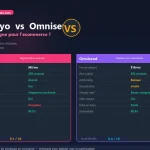
This article is part of our complete guide to ecommerce automation tools. For a direct head-to-head between the top two ecommerce email platforms, see our Klaviyo vs Omnisend comparison.
Why Email Marketing Automation Matters More Than Broadcast Email
The performance gap between automated and broadcast email is substantial — and it’s worth understanding before you pick a tool. Segmented, behavior-triggered campaigns generate 760% more revenue than non-segmented broadcast sends. Abandoned cart sequences produce an average of $3.65 in revenue per recipient — the highest of any email flow type — and stores that send the first recovery email within 60 minutes recover 3x more carts than those waiting 24 hours.
The global cart abandonment rate sits at 76.8% in 2026. That means for every 100 people who add something to a cart, 77 leave without buying. Email automation is your recovery system for that 77%. It runs on every session where a customer doesn’t convert, and it does it without you lifting a finger.
The platforms below are ranked by automation depth, ecommerce-specific features, and the revenue stages where they produce the best results.
1. Klaviyo — Best for Data-Driven Ecommerce Brands
Klaviyo is the dominant email marketing platform in the Shopify ecosystem for a reason: its entire architecture is built around ecommerce behavioral data. Every browse, click, cart action, and purchase syncs in real time to power segments and flows that update automatically as customer behavior changes.
Here’s what that means practically. You can build abandoned cart, welcome, post-purchase, browse abandonment, and win-back flows with full conditional branching. You can A/B test individual emails inside flows — not just subject lines, but full content and timing tests. You get predictive analytics: customer lifetime value, churn risk score, expected next order date. Smart Send Time uses AI to determine the optimal delivery window per recipient. And flow revenue attribution works at the email level, so you know exactly which messages are driving purchases.
The honest limitation worth mentioning: Klaviyo’s learning curve is real. Getting full value requires a dedicated operator or agency. Stores under $500K in revenue typically use 20% of its capabilities while paying full price. It’s free up to 250 contacts, with email plans from $20/month (500 contacts) scaling to $240/month at 10K contacts. You can learn about Klaviyo’s partner program here, or try Klaviyo free here.
2. Omnisend — Best Value for Growing Ecommerce Stores
Under $500K GMV and watching your margins? Omnisend is the right tool at this stage — professional automation at roughly 30% lower cost than Klaviyo.
It covers email, SMS, web push notifications, and WhatsApp from one interface, with 40+ pre-built ecommerce workflow templates that can be live within hours of installation. Most stores have their abandoned cart and welcome flows running on day one. That speed matters when you’re building the channel from scratch.
Omnisend also does things Klaviyo doesn’t — like managing multiple Shopify storefronts under one login, and offering 24/7 live chat support even on the free plan. The free plan itself is genuinely functional: 500 emails/month with full automation access, which covers early-stage stores comfortably. Standard plans run from $16/month, or roughly $132/month at 10K contacts — 45% cheaper than Klaviyo at the same tier.
The honest limitation: no A/B testing inside flows, no predictive CLV segmentation. For stores where those capabilities matter, Omnisend becomes a ceiling rather than a floor. You can check Omnisend’s partner program here, or try Omnisend free here.
3. ActiveCampaign — Best for CRM + Email Combined
This one’s different from the rest. ActiveCampaign combines email marketing, marketing automation, and a full CRM in one platform — and that combination matters specifically for founders selling higher-priced products where relationship management is part of the sales process.
Pure email tools like Klaviyo and Omnisend don’t offer pipeline management. ActiveCampaign does. You get a visual automation builder with 135+ triggers and actions, a built-in CRM with pipeline management and lead scoring, behavioral triggers (site visits, link clicks, purchase events, custom API events), and predictive sending with AI-powered send time optimization. Deep Shopify and WooCommerce native integrations come standard.
Plans start at $15/month for 1K contacts. There’s no free plan, but a 14-day trial is available. Worth being honest about: it’s more complex to configure than Klaviyo or Omnisend, and ecommerce-specific templates are fewer than on dedicated ecommerce platforms. It’s better suited to stores where the sales process involves multiple touchpoints before purchase. ActiveCampaign’s affiliate program offers 20-30% recurring commission.
4. Drip — Best Ecommerce CRM for Mid-Size Brands
Drip positions itself as the ecommerce CRM rather than just an email marketing tool — and for established brands between 2,500 and 50,000 contacts, that distinction matters.
It’s built specifically for online stores with deep integrations for Shopify, WooCommerce, Magento, and BigCommerce, and a visual workflow builder that handles complex multi-step customer journeys. The revenue attribution reporting per automation workflow is particularly strong — you can see exactly which flows are generating which revenue, not just opens and clicks.
Drip uses behavior-based segmentation via purchase history, RFM scoring, and custom fields. It also covers multi-channel flows combining email + SMS + social retargeting in one workflow. On pricing: one tier, starting at $39/month for up to 2,500 contacts. Simple — no plan tiers to navigate. The limitation: pricier than Omnisend at entry level, so smaller stores may find better value starting with Omnisend and migrating later. Drip’s affiliate program is available for qualified partners.
5. MailerLite — Best for Beginners and Budget-Constrained Stores
Not everyone needs to start with Klaviyo. For early-stage stores under 1,000 contacts that need functional automation at minimal cost, MailerLite is the right starting point.
It delivers a clean, modern automation builder with branching logic, pre-built templates for welcome, abandoned cart, and post-purchase flows, and landing pages and popup forms included. A/B testing is available for campaigns (not flows). The free forever plan covers 1,000 contacts and 12,000 emails/month — more generous than almost anything else at zero cost. Paid plans start from $10/month.
The reality is you’ll outgrow it. There are no behavioral triggers from product usage, no predictive analytics, no revenue attribution at the flow level. But a working welcome series and abandoned cart flow on MailerLite outperforms a half-configured Klaviyo setup with no active flows. Prove the channel first, then upgrade. MailerLite’s affiliate program pays 30% recurring commission for 12 months.
6. Brevo (formerly Sendinblue) — Best for Multi-Channel on a Budget
Brevo solves a problem most email tools ignore: transactional emails. It’s one of the few platforms that includes transactional email — order confirmations, shipping notifications, receipts — alongside marketing automation in one account, eliminating the need for a separate service like SendGrid or Postmark.
Beyond that, it covers SMS, WhatsApp, and push notifications on a single platform, with marketing automation driven by behavioral triggers. Contact scoring and a basic deal pipeline add light CRM capabilities. The pricing model is worth noting: Brevo charges based on email volume, not contact count — an advantage for stores with large lists but infrequent sends. Free plan allows 300 emails/day with unlimited contacts; paid plans from $9/month.
The honest limitation: ecommerce-specific features are less developed than Klaviyo or Omnisend, and the Shopify integration lacks the behavioral depth of dedicated ecommerce platforms. Brevo’s partner program offers commission on referred accounts.
7. Postscript — Best for SMS-First Ecommerce Automation
If your audience responds better to SMS than email, build your automation stack around SMS. Postscript is the tool for that.
It’s SMS-native, built exclusively for Shopify, with automation specifically designed for text message marketing. SMS abandoned cart messages see 98% open rates versus email’s 50% — for stores whose customers are mobile-first, that gap is decisive. Postscript handles abandoned cart, welcome, post-purchase, and win-back flows via SMS, plus two-way conversational SMS with automated responses. Subscriber growth tools — popups, keywords, QR codes — are included, along with TCPA and GDPR compliance management built in.
Plans start from $100/month for high-volume SMS sending. It’s a free trial to start. Postscript’s partner program is available for agencies and affiliates.
How to Choose: Decision Framework
Three variables determine the right email marketing automation tool for your ecommerce store: revenue stage, technical sophistication of your marketing team, and the complexity of automation workflows you actually need.
For stores under $500K GMV, the optimal choice is a value-focused ecommerce platform (Omnisend or MailerLite) that covers core flows without requiring a dedicated operator. Stores between $500K and $2M GMV benefit from migrating to Klaviyo or Drip, where behavioral segmentation and predictive analytics produce measurable revenue improvements. Stores with high-ticket products or longer sales cycles should evaluate ActiveCampaign’s CRM capabilities. In all cases, launch the abandoned cart sequence first — stores that send the first recovery email within 60 minutes recover 3x more carts, and a three-email sequence generates 6.5x more revenue than a single reminder.
| Revenue Stage | Recommended Tool | Monthly Cost (10K contacts) |
|---|---|---|
| Under $100K GMV | MailerLite or Omnisend Free | $0–$16 |
| $100K–$500K GMV | Omnisend Standard | $65–$132 |
| $500K–$2M GMV | Klaviyo or Drip | $39–$240 |
| $2M+ GMV | Klaviyo | $240+ |
| High-ticket / longer cycle | ActiveCampaign | $75+ |
| SMS-primary strategy | Postscript + Klaviyo | $100+ |
Frequently Asked Questions
What is the best free email marketing tool for ecommerce?
Omnisend’s free plan is the strongest for ecommerce — it includes full automation access (welcome series, abandoned cart, post-purchase flows) within a 500-email/month limit and 250 contacts. MailerLite’s free plan allows 1,000 contacts and 12,000 emails/month, but with less ecommerce-specific automation. For pure volume at zero cost, MailerLite wins. For ecommerce functionality, Omnisend wins.
Does email automation work for WooCommerce?
Yes. Klaviyo, Omnisend, ActiveCampaign, Drip, and MailerLite all have native WooCommerce plugins that sync orders, customers, and behavioral events. The setup process is straightforward via plugin installation — no custom development required.
How quickly should I send an abandoned cart email?
Within 60 minutes of abandonment. Research consistently shows the first-hour recovery rate is 3x higher than emails sent after 24 hours. A three-email sequence — at 60 minutes, 24 hours, and 72 hours — generates 6.5x more revenue than a single reminder. All platforms in this list support this timing natively.
What’s the difference between email marketing and email automation?
Email marketing typically refers to broadcast campaigns sent to a list at a scheduled time: newsletters, promotions, announcements. Email automation refers to triggered sequences that activate based on specific customer behavior — cart abandonment, first purchase, inactivity, browsing patterns. Automation generates significantly higher revenue per recipient because messages are contextually relevant to what the customer just did.
Key Takeaways
- Highest ROI first: Set up email marketing automation for ecommerce — starting with abandoned cart — before any other flow. It’s the fastest revenue recovery mechanism available.
- Match tool to stage: Omnisend for under $500K GMV, Klaviyo for above. Don’t overpay for complexity you can’t yet use.
- SMS complements email: A combined email + SMS approach (within platforms like Omnisend or Klaviyo) recovers more abandoned carts than either channel alone.
- Start simple: A working welcome series and abandoned cart flow on MailerLite outperforms a half-configured Klaviyo setup with no active flows.
For the full automation stack beyond email, see our guide: Best Ecommerce Automation Tools 2026.
To learn how to structure and set up your flows, see: How to Build Ecommerce Email Flows That Convert.
For the complete Klaviyo vs Omnisend breakdown: Klaviyo vs Omnisend: Best Email Automation for Ecommerce 2026.