
Klaviyo vs Omnisend: it’s one of the first real decisions a growing ecommerce brand has to make — and the wrong answer costs you either money (Klaviyo at small scale) or growth (Omnisend at large scale).
Both platforms are built specifically for ecommerce. Both integrate natively with Shopify and WooCommerce. Both run abandoned cart flows, welcome sequences, and post-purchase automations. The gap between them isn’t about basic capabilities — it’s about data depth, segmentation precision, and price efficiency at different revenue stages.
This comparison is based on testing both platforms across real Shopify stores. Not marketing copy from either vendor. Here’s what actually differs, where it matters, and which platform wins for your specific situation.
This article is part of our complete guide to ecommerce automation tools — the broader automation stack that email platforms fit into.
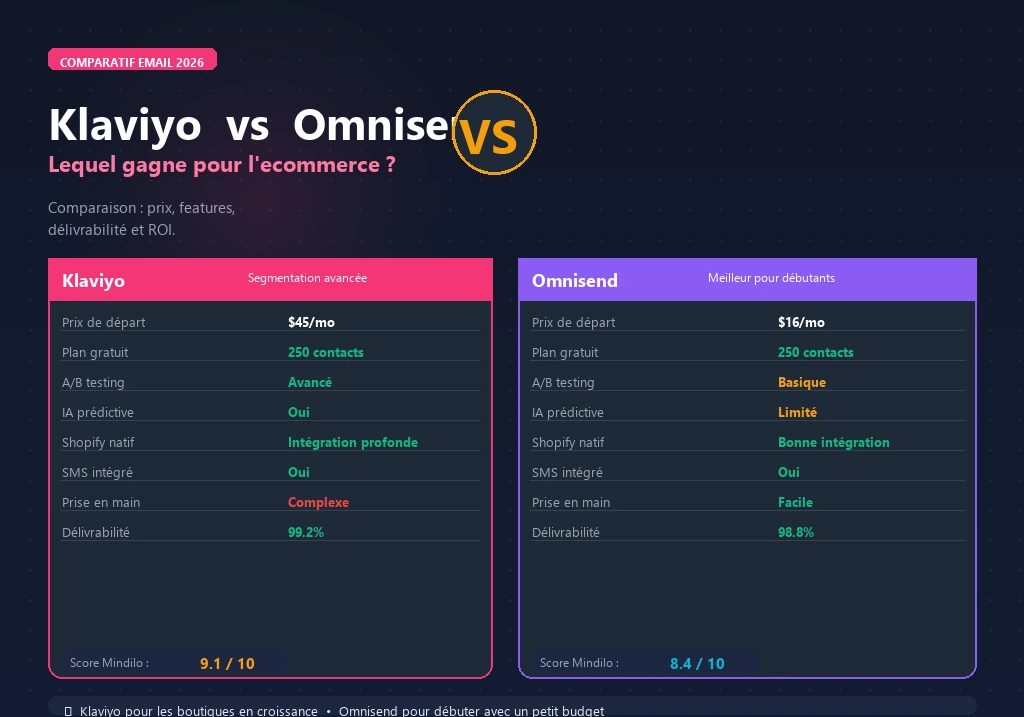
Quick Comparison Table
| Feature | Klaviyo | Omnisend |
|---|---|---|
| Best for | $500K+ GMV stores | Under $500K GMV stores |
| Pricing (10K contacts) | $240/month | $132/month |
| Free plan | ✅ 250 contacts | ✅ 500 emails/month |
| Email automation | ✅ Advanced flows + A/B | ✅ Pre-built templates |
| SMS marketing | ✅ | ✅ |
| Web push notifications | ❌ | ✅ |
| Predictive AI (CLV, churn) | ✅ | ❌ |
| Segmentation depth | ⭐⭐⭐⭐⭐ | ⭐⭐⭐ |
| Ease of use | ⭐⭐⭐ | ⭐⭐⭐⭐⭐ |
| Support (free plan) | ❌ | ✅ 24/7 live chat |
| Shopify integration | ✅ Native | ✅ Native |
| WooCommerce integration | ✅ | ✅ |
| Multi-store management | ❌ | ✅ |
What Is Klaviyo?
Klaviyo is an email and SMS marketing platform built specifically for ecommerce, used by over 130,000 stores globally. Its core architecture is a unified customer data platform that syncs real-time behavioral data from your store — every browse session, product view, cart addition, purchase, and return — and uses that data to power dynamic segmentation and automated flows.
Unlike general email marketing tools, Klaviyo’s segmentation engine operates on live event streams rather than static list membership. Segments update in real time as customer behavior changes. That’s a meaningful technical difference, and it shows up in revenue attribution. Key differentiating features include predictive analytics (customer lifetime value, churn risk score, expected next order date), A/B testing inside automation flows, and a dedicated IP option for high-volume senders.
Klaviyo is the dominant email platform for ecommerce brands above $500K GMV in the Shopify ecosystem. On pricing: it’s free up to 250 contacts with 500 emails/month; email plans run from $20/month (500 contacts) to $240/month at 10K contacts; SMS credits are billed separately on top.
What Is Omnisend?
Omnisend is an omnichannel marketing automation platform for ecommerce, covering email, SMS, web push notifications, and WhatsApp from a single interface. Founded in 2014, it serves over 100,000 ecommerce brands and positions itself as the accessible, value-focused alternative to Klaviyo.
Here’s the thing about Omnisend that makes it genuinely compelling: its workflow builder uses pre-built automation templates that can be live without prior email marketing experience. Fastest path from signup to active abandoned cart recovery in the market. Pricing runs 15–30% lower than Klaviyo at comparable contact tiers, and it offers 24/7 live chat support on all plans including free — which is unusual in this space.
Omnisend’s reporting prioritizes clarity over depth: campaign revenue attribution, unsubscribe rates, click maps — without the complex analytics dashboards that Klaviyo requires time to master. On pricing: free plan gives 500 emails/month with full automation access and 250 contacts; Standard starts from $16/month (500 contacts) or roughly $132/month at 10K contacts; Pro from $59/month adds unlimited web push and advanced reporting.
Automation Flows: Klaviyo vs Omnisend
This is where the meaningful gap shows up.
Klaviyo Automation
Klaviyo flows are built on a visual drag-and-drop editor with full conditional branching logic. You can split flows based on any customer property or event: cart value, purchase history, predicted CLV tier, product category, or custom attributes synced from your store.
What Klaviyo enables that Omnisend doesn’t: A/B testing individual emails inside a flow (not just subject lines — full content and timing tests); conditional splits based on predicted CLV or churn risk scores; Smart Send Time optimization where AI determines optimal send time per recipient; and flow analytics with per-email revenue attribution and statistical significance.
In practice, a Klaviyo post-purchase flow can split immediately based on whether a customer’s predicted CLV puts them in the top 20% — sending that high-value segment into a VIP nurture track with different content, timing, and offers than the standard track. That’s the kind of segmentation that compounds over time.
Omnisend Automation
Omnisend ships with 40+ pre-built automation templates — welcome series, abandoned cart, post-purchase, browse abandonment, win-back — configured for ecommerce and launchable within hours of installation. Most stores have abandoned cart and welcome flows live on day one.
What Omnisend does well: multi-channel flows that combine email + SMS + push notification in one sequence; fast setup without requiring data analysis skills; and clean, readable analytics. What it doesn’t have: A/B testing inside flows, predictive analytics for branching, or the granular conditional logic Klaviyo offers.
The verdict on automation: for standard ecommerce flows — welcome, abandoned cart, post-purchase, win-back — both platforms perform comparably in revenue recovery. The gap opens when you need flow logic driven by predictive data or statistical testing inside the automation itself.
Segmentation: Where Klaviyo Pulls Ahead
Klaviyo’s segmentation engine is its most significant advantage. The difference isn’t just feature depth — it’s the quality of decisions you can make with the data.
Klaviyo gives you real-time event-based segments that update as behavior occurs, predictive CLV to segment customers by projected 90-day or 1-year revenue, churn risk scores to proactively target customers showing disengagement signals, and the ability to build custom properties from any data source via API.
Omnisend’s segmentation is tag-based and list-based, with purchase history filtering, engagement-based segments (clicked, opened, didn’t purchase), and standard ecommerce properties like cart value and product category.
For a store selling across multiple product lines with repeat purchase cycles, Klaviyo allows precision that Omnisend can’t match: “customers who bought Product X more than 60 days ago, have a churn risk score above 70, and have a predicted CLV above $500” — triggering a specific reactivation sequence. For most stores under $1M in revenue, this level of precision isn’t yet the limiting factor. The limiting factor is having enough flows running in the first place.
Pricing: The Real Cost at Scale
| Contacts | Klaviyo (Email) | Omnisend (Standard) | Difference |
|---|---|---|---|
| 250 | Free | Free | — |
| 1,000 | $45/mo | $20/mo | -$300/yr |
| 5,000 | $100/mo | $65/mo | -$420/yr |
| 10,000 | $240/mo | $132/mo | -$1,296/yr |
| 50,000 | ~$700/mo | ~$400/mo | -$3,600/yr |
At 50,000 contacts, you’re paying approximately $15,600 more per year for Klaviyo than for Omnisend. The question is whether Klaviyo’s additional capabilities generate more than $15,600 in incremental revenue at that scale — and for data-driven stores above $1M GMV with strong email programs, the answer is typically yes.
Deliverability: Closer Than You Think
Deliverability is often cited as a reason to choose Klaviyo, but the real-world gap for most stores is smaller than claimed.
Both platforms use shared IP infrastructure by default. Klaviyo offers dedicated IPs on higher plans, typically needed above 100,000 emails/month. For stores sending under that volume, deliverability is primarily determined by list hygiene and authentication setup (SPF, DKIM, DMARC) — not the sending platform itself.
In independent testing across comparable Shopify stores, inbox placement rates between Klaviyo and Omnisend differ by less than 2% when both are properly configured.
Which Should You Choose?
Choose Klaviyo if:
- Your store does $500K+ GMV annually
- You have (or plan to hire) a dedicated email marketing operator
- Advanced segmentation and predictive analytics are part of your retention strategy
- You need A/B testing inside flows to optimize systematically
- You’re building a long-term email program that will grow with your store
Choose Omnisend if:
- Your store is under $500K GMV and cost efficiency matters
- You want to launch professional automations quickly without a learning curve
- You manage multiple Shopify storefronts (multi-store support is native in Omnisend)
- You want web push notifications as part of your retention stack
- Support responsiveness matters — omnisend’s 24/7 live chat is consistently faster
The practical decision framework:
If you’re choosing today and you’re under $50K/month in revenue — start with Omnisend. Run your core flows. Prove the channel. When email is generating 25–30% of your revenue and you’ve maxed out what Omnisend’s segmentation can do, migrate to Klaviyo. That migration is easier than it looks, and you’ll have the revenue to justify the cost by then.
Frequently Asked Questions
Can I migrate from Omnisend to Klaviyo later?
Yes. The process involves exporting your contact list with custom properties, importing into Klaviyo, reconfiguring your flows, and reconnecting your Shopify integration. Most stores complete the migration in 1–2 weeks. Klaviyo has a dedicated migration guide and the Shopify integration sync pulls in historical order data automatically.
Does Klaviyo integrate with WooCommerce?
Yes. Klaviyo has a native WooCommerce plugin that syncs orders, customers, and behavioral data in real time. Omnisend also has native WooCommerce support. Both work equally well on WooCommerce stores.
Is Omnisend’s free plan actually usable?
Yes, for testing and early-stage stores. The free plan includes full automation access — welcome series, abandoned cart — but limits you to 500 emails/month. For a store with under 200 contacts, this is functional. Above that, you’ll need a paid plan quickly.
Which has better Shopify integration — klaviyo or Omnisend?
Klaviyo’s Shopify integration is deeper — it syncs more behavioral events (product views, collection views, search queries) and offers more granular data access via the API. For most stores, Omnisend’s integration covers everything needed for standard email marketing. The Klaviyo advantage shows up when building segmentation based on on-site behavior beyond purchase events.
Can both tools handle SMS marketing?
Yes. Both Klaviyo and Omnisend include SMS marketing with US/international coverage and charge similarly for SMS credits. For SMS-first strategies, Klaviyo’s unified profile — email and SMS behavior in one view — gives it an analytical edge.
Key Takeaways
- Klaviyo wins on: data depth, segmentation precision, flow A/B testing, predictive analytics
- Omnisend wins on: price efficiency, ease of use, setup speed, multi-store support, push notifications, support quality
- The revenue threshold: $500K GMV is where Klaviyo’s capabilities begin to justify the price premium for most stores
- Both platforms cover the core ecommerce automation flows (welcome, abandoned cart, post-purchase, win-back) effectively
For a full breakdown of how email automation fits into your broader ecommerce automation system, see our guide: Best Ecommerce Automation Tools 2026.
To learn how to set up the flows themselves, see: How to Build Ecommerce Email Flows That Convert.
And if you’re evaluating the full range of email marketing tools beyond these two, see: Best Email Marketing Automation Tools for Ecommerce 2026.