
The AI ecommerce market hit $8.65 billion in 2026. 90% of retailers are now using AI in some form, and 69% of those who implemented it report direct revenue increases they can actually attribute to it.
The problem isn’t that AI automation tools for ecommerce don’t exist — it’s that they’ve multiplied so fast that the signal is buried in noise. Every tool claims to be AI-powered. Few of them are worth the subscription. This guide covers the eight AI automation tools that are producing measurable results for Shopify and WooCommerce stores in 2026, organized by function, with honest data on what each tool actually does and where it’s worth the investment.
For the full automation stack that AI tools plug into, see our guide: Best Ecommerce Automation Tools 2026.
What AI Automation Actually Means for Ecommerce
Let me be direct about the distinction that matters: rule-based automation executes predefined actions when predefined triggers occur. AI automation learns from historical data to make context-dependent decisions without requiring manual rule updates. That’s not marketing language — it’s a real architectural difference that shows up in outcomes.
In practice, AI ecommerce automation operates across four domains: customer service (conversational AI handles inquiries with contextual understanding, not just keyword matching), inventory management (predictive models forecast demand and trigger reorders), marketing personalization (AI determines optimal content, timing, and channel per customer), and workflow orchestration (AI agents route tasks and make branching decisions based on real-time signals).
According to 2026 research, companies that invest in AI customer service see $3.50 back for every dollar spent, and AI inventory management reduces stockouts by up to 11% while cutting overstock write-offs by 14%. The market is projected to reach $17 billion by 2030, growing at 23% annually.
1. Gorgias — Best AI Customer Service for Ecommerce
For stores processing more than 100 support tickets a month, Gorgias is the most purpose-built option available.
It’s the leading helpdesk platform for ecommerce, with native Shopify and WooCommerce integrations that pull order data directly into the support interface. Its AI agents handle order status inquiries, return requests, WISMO questions — with contextually accurate responses, not generic scripted replies. Top merchants hit a 93% automation rate. That means 93 of every 100 tickets resolved without a human agent touching them.
The consistent ROI data: Gorgias customers average a 40% reduction in support costs within 90 days. During peak season — black Friday, holiday — that’s the difference between hiring temporary staff and not needing to. Agents can also view and modify Shopify orders directly from the Gorgias interface, so they can issue refunds and process returns without switching tools.
Plans start from $10/month and scale with ticket volume. You can check the Gorgias Partner Program here or try Gorgias directly.
For a full implementation guide, see: How to Use AI to Automate Ecommerce Customer Service
2. Klaviyo AI — Best for Predictive Email & SMS Automation
Klaviyo’s AI layer — called Klaviyo Intelligence — sits on top of its email and SMS automation platform and introduces predictive capabilities that standard email tools don’t have. Instead of triggering flows based on what happened, it anticipates what will happen: which customers are about to churn, which are likely to buy again soon, and what each contact’s expected lifetime value looks like.
Here’s what that means in practice. Predictive CLV shows expected revenue per customer over 90 days and 1 year — usable directly in segments and flow branching. The churn risk score identifies customers showing disengagement signals before they lapse. Smart Send Time determines the optimal send window per individual contact. Product recommendation blocks in emails are AI-generated based on browse and purchase history. Subject line AI generates and tests variants automatically.
Stores using Klaviyo’s predictive CLV segmentation to target high-value customer retention flows report 20–35% improvement in repeat purchase rates versus non-segmented flows. That’s a material lift from features already included in paid Klaviyo plans, which start from $20/month. Klaviyo’s Partner Program uses a revenue-share model for referred accounts.
For the full email automation comparison, see: Best Email Marketing Automation Tools for Ecommerce 2026
3. Shopify Magic — Best Free AI for Shopify Merchants
If you’re on Shopify and ignoring Shopify Magic because it came bundled with your plan, that’s a mistake.
Shopify Magic is the suite of AI features embedded directly into the Shopify admin — not a standalone tool, but AI woven into the workflows you’re already using. It generates product description first drafts from product title and attributes in 10–15 seconds. It suggests email subject lines for Shopify Email campaigns. It drafts replies for Shopify Inbox conversations. It removes image backgrounds and generates product photo scenes. It auto-generates return policies, privacy policies, and terms based on your store type.
The efficiency math on product descriptions alone: 10–15 seconds versus 3–5 minutes per product means 25–42 hours of content work eliminated for a store with 500 SKUs. That’s not a marginal improvement. And it costs nothing — included with all Shopify plans.
The limitation worth being clear about: Shopify Magic is content assistance, not operational automation. It won’t run workflows or make decisions. For that, you need Make, Zapier, or Shopify Flow.
4. Make AI Scenarios — Best for AI-Enhanced Workflow Automation
This is for the builders who want AI reasoning embedded directly in their automation — not as a separate tool, but as a decision-making step inside a larger workflow.
Make’s visual workflow canvas is already the strongest platform for complex ecommerce automation. Its AI integration adds a new capability: AI modules that classify inputs, generate content, or make routing decisions — with the rest of the scenario executing based on that output. One workflow can read an incoming support ticket, classify it by urgency and type, route it to the appropriate queue, generate a response draft, and log the outcome. All automated, all in sequence.
The ecommerce use cases are specific and actionable: pull product data from Shopify, have an AI step generate a description, push it back to the product page; aggregate weekly sales data and have AI generate a plain-English summary for Slack; flag unusual order patterns (potential fraud, bulk orders) before fulfillment; generate review response drafts queued for human approval. Plans start from $9/month, with AI module calls potentially incurring additional API costs depending on the LLM used. Make’s Partner Program is available for agencies and affiliates.
For the full Make vs Zapier comparison: Make vs Zapier for Ecommerce: Which Tool Wins in 2026?
5. Tidio Lyro — Best AI Chatbot for Small to Mid-Size Ecommerce
Want AI customer support without the Gorgias price point? Tidio’s Lyro AI engine is the answer for stores under $1M GMV.
Lyro handles live chat and automated support across Shopify, WooCommerce, BigCommerce, and Magento. It’s trained on your product catalog, FAQ content, and store policies, enabling it to answer product-specific questions, order status inquiries, and return policy questions without human agents. It answers up to 70% of customer questions automatically and escalates to human agents when confidence is low — so you’re not losing customers on edge cases.
Stores using Lyro report a 42% reduction in human support tickets within 30 days of activation. That’s a fast payback. The free plan covers 50 Lyro conversations/month, with paid plans from $29/month. Tidio’s affiliate program is available for partners.
6. Triple Whale — Best AI Analytics for Ecommerce
Spending $5K+ a month on paid advertising? Triple Whale was built for this specific problem.
It’s an ecommerce analytics platform with an AI layer called Moby — a conversational analytics interface that answers plain-English questions about your store’s performance. Ask “Which ad set had the best ROAS last 30 days?” and get an instant answer with supporting data. Beyond dashboards, Triple Whale’s AI provides first-party attribution modeling that outperforms Meta and Google’s native attribution during iOS privacy changes — which is where most stores are bleeding money without knowing it.
Other AI features worth noting: revenue forecasting based on historical patterns and seasonal signals, creative analysis that identifies which ad creatives are driving performance and why, cohort analysis that segments customers by behavior and predicts retention patterns, and anomaly alerts that detect unusual performance changes before you notice manually.
Plans start from $129/month with enterprise plans available. Triple Whale’s Partner Program pays 20% recurring commission.
7. Jasper AI — Best for AI Content at Scale
Large product catalog? High content production needs? Jasper compresses the time investment dramatically.
It’s a generative AI writing platform with ecommerce-specific templates for product descriptions, Amazon listings, meta titles, ad copy, and blog content. It’s not a workflow automation tool — it’s a content production accelerator. The distinction matters: Jasper speeds up the writing work itself, while tools like Make or Shopify Magic automate the workflows around content.
The results are specific. A home goods store with 1,400 SKUs regenerated all product descriptions in 3 weeks using Jasper — a project that would have taken 3 months manually — and saw a 34% increase in organic search impressions over the following 60 days. Other use cases: SEO meta title and description generation for product pages, ad copy variants for Facebook and Google campaigns, email campaign copy drafts, and blog content drafts that require human editing before publishing.
Plans start from $39/month per seat. Jasper’s affiliate program pays 25% recurring commission.
8. Rebuy — Best AI Personalization for Shopify
Above $500K GMV and looking to increase average order value? Rebuy is worth a close look.
It uses machine learning to power product recommendations, smart cart upsells, post-purchase offers, and reorder landing pages — all based on individual customer behavior and purchase history. Unlike static “you might also like” widgets, Rebuy’s recommendations update in real time based on what the customer is doing in the current session. The Smart Cart is an AI-powered cart upsell widget that adjusts recommendations based on cart contents. Post-purchase offers are one-click upsells shown immediately after checkout before the thank-you page.
Rebuy also integrates directly with Klaviyo and Omnisend for personalized product recommendation blocks in email — so the AI personalization extends beyond the storefront into your email flows. Customers report an average 15% increase in average order value within 60 days of full implementation. Plans start from $99/month and scale with store revenue. Rebuy’s Partner Program is available for agencies and affiliates.
AI Tool Selection Framework
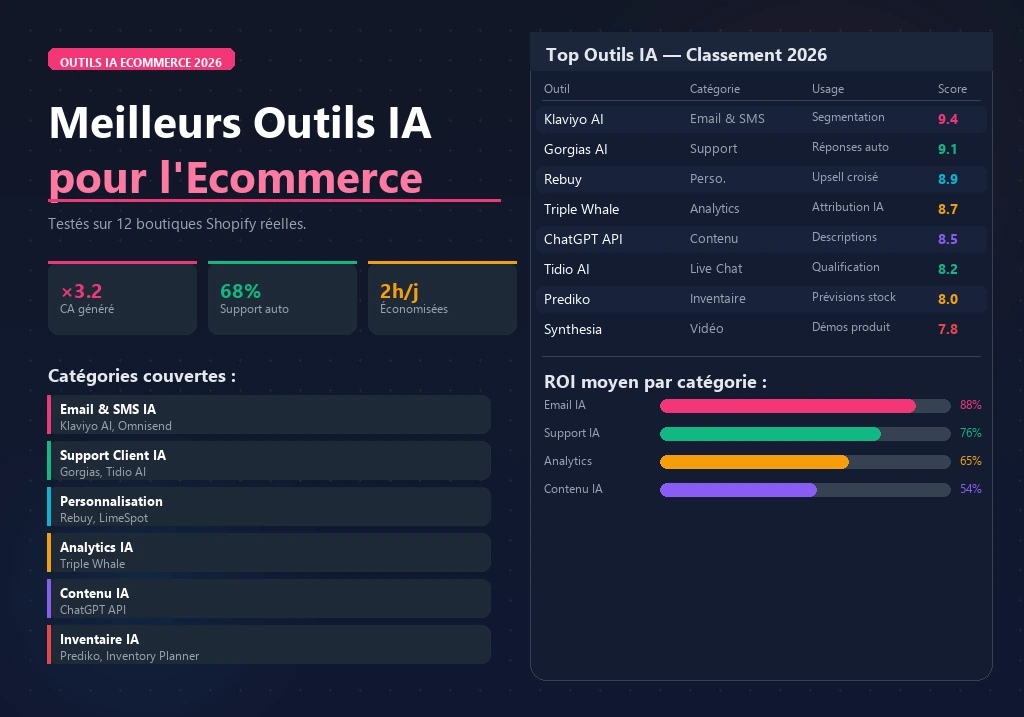
The highest-ROI AI implementations for ecommerce in 2026 follow a consistent priority sequence: (1) AI customer service automation, which reduces support costs by 30–40% while maintaining response quality; (2) predictive email automation, which improves repeat purchase rates by 20–35% through churn prevention and personalized timing; (3) AI product recommendations, which increase average order value by 10–15% when implemented across cart and post-purchase touchpoints; (4) AI analytics and attribution, which improves paid advertising efficiency for stores spending $5K+ monthly on ads.
Worth being direct about: stores that implement AI tools before establishing clean data infrastructure and documented operational processes consistently underperform against those that automate systematically built workflows. AI amplifies what already works. It does not fix broken operational foundations.
| Problem | AI Tool | Expected ROI |
|---|---|---|
| High support ticket volume | Gorgias, Tidio Lyro | 40% cost reduction in 90 days |
| Low repeat purchase rate | Klaviyo AI | 20–35% retention improvement |
| Low average order value | Rebuy | 15% AOV increase in 60 days |
| Large product catalog content | Jasper AI, Shopify Magic | 80% time reduction |
| Complex workflow decisions | Make AI | Variable by workflow |
| Paid ad attribution gaps | Triple Whale | Improved ROAS measurement |
Frequently Asked Questions
Do I need to be technical to use AI tools for ecommerce?
No. Gorgias, Tidio, Klaviyo AI, and Shopify Magic require zero technical knowledge — they’re configured through UI interfaces designed for non-technical operators. Make AI scenarios require comfort with workflow automation but not coding. Rebuy and Triple Whale have onboarding support teams for initial setup.
Which AI tool should I implement first?
Start with AI customer service — gorgias or Tidio — if you’re handling 50+ tickets/month. The cost reduction is immediate and measurable. If email is your primary revenue channel, prioritize Klaviyo’s predictive features. If you have a large catalog, Shopify Magic for product descriptions is free and generates immediate time savings.
Will AI tools replace my support team?
AI handles volume — the routine, repetitive inquiries that consume 60–70% of support time. It routes complex, sensitive, or escalated cases to human agents. The practical result is that a 3-person support team can handle the volume previously requiring 5, or a 1-person team can maintain quality through 3x growth. Complete replacement of the support function isn’t the realistic outcome for most brands.
How do AI automation tools connect with Shopify and WooCommerce?
Most tools in this guide have native integrations. Gorgias, Klaviyo, Rebuy, and Triple Whale integrate with Shopify via the app store with OAuth authentication. Make and Zapier use API connections that work with both Shopify and WooCommerce. Tidio has plugins for both platforms. Setup typically takes under 30 minutes for native integrations.
Key Takeaways
- Best ROI first: AI customer service (Gorgias/Tidio) and predictive email (Klaviyo AI) produce the fastest measurable returns
- Free starting point: Shopify Magic is available to all Shopify merchants at no additional cost — use it immediately for product descriptions
- Match tool to problem: AI analytics via Triple Whale only makes sense when you have $5K+/month in ad spend to optimize
- Data first: AI tools amplify what already works — fix data quality and operational foundations before adding AI complexity
- Stack incrementally: Add one AI automation tool for ecommerce at a time, measure impact for 60 days, then layer the next
For the complete automation stack these tools plug into, see: Best Ecommerce Automation Tools 2026.
For no-code workflow automation that powers AI orchestration, see: Make vs Zapier for Ecommerce: Which Tool Wins in 2026?.